
Caso Masacres de Río Negro vs. Guatemala: Medidas de reparaciones
– Vanwege de Spaanstalige doelgroep van de poster, is hij alleen beschikbaar in het Spaans. De context van de poster is hieronder in het Spaans en Engels te lezen. –
Contexto del póster Caso Masacres de Río Negro vs. Guatemala:
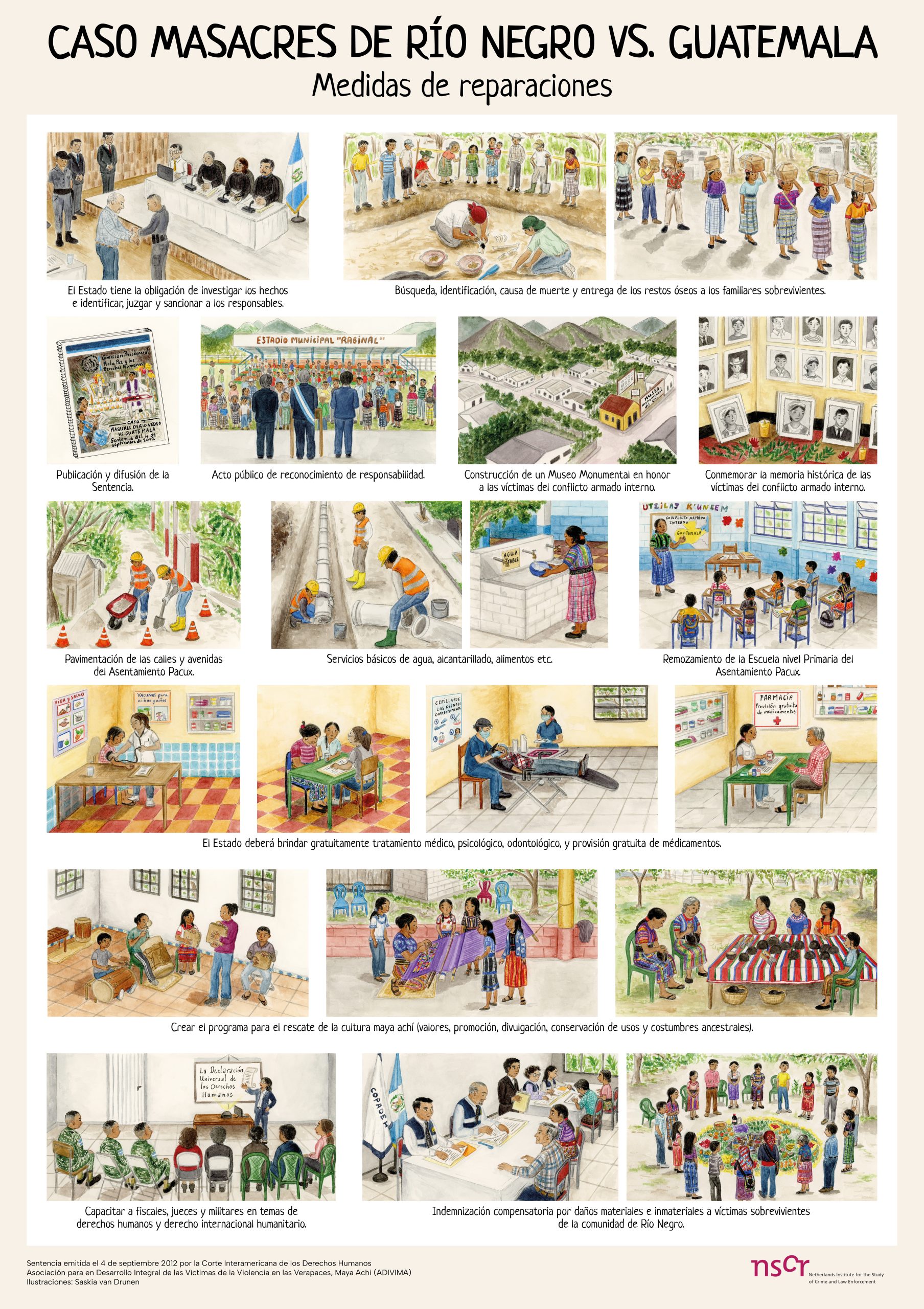
Como resultado de una colaboración entre la investigadora senior del NSCR, Mijke de Waardt, y la ilustradora Saskia van Drunen, este póster fue creado conjuntamente con la organización sociojurídica guatemalteca ADIVIMA. Será utilizado por ADIVIMA en capacitaciones y talleres con personas sobrevivientes de las masacres de Río Negro en Guatemala.
El póster visualiza las reparaciones que la Corte Interamericana de Derechos Humanos (Corte IDH) ordenó al Estado guatemalteco implementar en 2012, en el caso Masacres de Río Negro vs. Guatemala. La idea del póster surgió a partir de un proyecto de investigación sociojurídica sobre cómo las personas sobrevivientes experimentan su derecho a la reparación. Este subestudio formó parte de un proyecto de investigación más amplio junto con Rianne Letschert, presidenta de la Universidad de Maastricht, en el que se analizaron cuatro casos ante distintos tribunales internacionales: la Corte IDH, el Tribunal Europeo de Derechos Humanos (TEDH), las Cámaras Extraordinarias de los Tribunales de Camboya (ECCC) y la Corte Penal Internacional (CPI). El objetivo fue comprender si, y de qué manera, las reparaciones a través de procedimientos de justicia internacional contribuyen a la justicia reparadora.
Las personas participantes en este subestudio pertenecen al pueblo maya achí. Vivieron una serie de masacres ocurridas en Río Negro, Guatemala, en el contexto de la construcción de una represa hidroeléctrica y del reasentamiento forzado durante la década de 1980, en el marco del Conflicto Armado Interno de Guatemala. Las víctimas de estas masacres tienen derecho a diversas formas de reparación, incluida una extensa lista de reparaciones ordenadas por la Corte IDH en 2012. Sin embargo, muchas de estas reparaciones aún no han sido implementadas y, con frecuencia, las víctimas no saben a qué tipos de reparación tienen derecho. Esperamos que el póster pueda enriquecer los diálogos en curso con las autoridades responsables de su implementación, reconociendo que la complejidad de estos procesos puede dificultar el acceso a la información.
Esperamos que el póster pueda enriquecer los diálogos en curso entre las personas sobrevivientes, ADIVIMA, la Corte y las autoridades responsables de la implementación, reconociendo que la complejidad de estos procesos puede dificultar el acceso a la información.
Las reparaciones constituyen un derecho reconocido de las personas sobrevivientes y su implementación plena y significativa resulta fundamental.
Más información
Para más información, póngase en contacto con Mijke de Waardt
– English –
Background poster Río Negro massacres in Guatemala:
As a result of a collaboration between NSCR Senior researcher Mijke de Waardt and illustrator Saskia van Drunen, this poster was created together with the Guatemalan socio-legal organization ADIVIMA. It will be used by ADIVIMA in trainings and workshops with survivors of the Río Negro massacres in Guatemala.
The poster visualizes the reparations that the Inter-American Court of Human Rights (IACtHR) ordered the Guatemalan government to implement in 2012 in the case Massacres of Río Negro vs. Guatemala. The idea for the poster arose from a socio-legal research project on how survivors experience their right to reparation. This sub-study was part of a larger research project with Rianne Letschert, President of Maastricht University, examining four cases across different international courts: the IACtHR, the ECtHR, the ECCC, and the ICC. The aim was to understand whether, and how, reparations through international justice procedures contribute to reparative justice.
The participants in this sub-study belong to the Maya Achi people. They lived through a number of massacres that took place in Río Negro, Guatemala, in the context of the construction of a hydroelectric dam and forced resettlement that took place in the 1980s, during Guatemala’s Internal Armed Conflict. Victims of these massacres are entitled to several forms of reparation, including a long list of reparations ordered by the IACtHR in 2012. However, many of these reparations have not yet been implemented and victims often do not know to what kind of reparations they are entitled to.
We hope the poster can enrich ongoing conversations between survivors, ADIVIMA, and the Court, and the authorities responsible for implementation, while acknowledging that the complexity of these processes can make access to information challenging.
Reparations constitute a recognized right of these survivors, and their full and meaningful implementation is fundamental.
More information
For more information, please contact Mijke de Waardt

Het NSCR is onderdeel van de institutenorganisatie van de Nederlandse Organisatie voor Wetenschappelijk Onderzoek (NWO).