
Effectively reducing youth’s involvement in serious and organized crime
A consortium of researchers, policymakers and practitioners has set up the project EPIC: Explaining, Preventing, and Intervening in organized Crime involvement, with support from the Dutch Research Agenda (NWA). The aim of this research is to effectively reduce the involvement of young people in serious and organized crime.
The first phase of the project is completed. With support from NWA, the second phase of EPIC kicked off in March 2024 with five different empirical work packages (WP). This phase will run for four years and is currently in full swing.
Questions about EPIC? Please send an e-mail to epic@nscr.nl
Menu
- News >
Read about the latest developments, upcoming meetings and the newsletter(s). - Phase 1: the results >
- Phase 2: ongoing research >
- Phenomenon-based research: Young people’s exposure to and involvement in serious and organized crime (WP4)
- Phenomenon-based research: Offline and online pathways of young people’s involvement in serious and organized crime (WP5)
- Action-based research: Evaluating and further developing interventions aimed at the involvement of young people in serious and organized crime (WP6)
- Effect research: Examining the effectiveness of prevention programmes aimed at involvement in serious and organized crime (WP7)
- Effect research: What works for young people in resisting and stopping involvement in serious and organized crime? (WP8)
- Research team and partners >
As a consortium, we work closely with various partners throughout the Netherlands. - Contact >
Would you like to know more about how young people get involved in organized crime and how we can effectively reduce their involvement? Please send your question to one of our researchers!
News
Upcoming events
- 2028 EPIC conference.
More information will follow.
Newsletter (mostly in Dutch)
Would you like to stay up to date on our research projects and events? Sign up for the EPIC newsletter (in Dutch). The overview below lists all newsletters sent to date, ordered chronologically from oldest to newest:
- Nieuwsbrief 1: Kick-off EPIC-project (fase 1)
- Nieuwsbrief 2: Update voortgang fase 1
- Nieuwsbrief 3: Resultaten EPIC fase 1
- Nieuwsbrief 4: Kick-off EPIC (fase 2)
- Nieuwsbrief 5: Onderzochte interventies binnen EPIC
- Nieuwsbrief 6: Resultaten systematische literatuurstudies EPIC
- Nieuwsbrief 7: Update voortgang fase 2
- Nieuwsbrief 8: EPIC-leersessie 5 juni (opzetten en evalueren van interventies en aanpakken)
- Nieuwsbrief 9: Infographic: wie onderzoekt wat op dit moment? (juni 2025)
- Nieuwsbrief 10: Samenvatting EPIC-leersessie 5 juni 2025
- In English newsletter 11: Infographic: What are we currently investigating? (dec 2025)
- In English newsletter 12: Infographic: Myths and misconceptions about youth crime and effective interventions (sept 2026)
Phase 1 of EPIC:
the results
In the first, completed, phase of EPIC, existing scientific knowledge about the risk and protective factors for entering serious and organized crime was examined (work package 1). Further, nationally and internationally, the available interventions were mapped out, along with what is known about their effectiveness in reducing young people’s involvement in organized crime . To do so, both scientific knowledge (work package 2) and tacit knowledge (work package 3) were consulted.
Results of the systematic literature review in work package 1:
Risk and protective factors
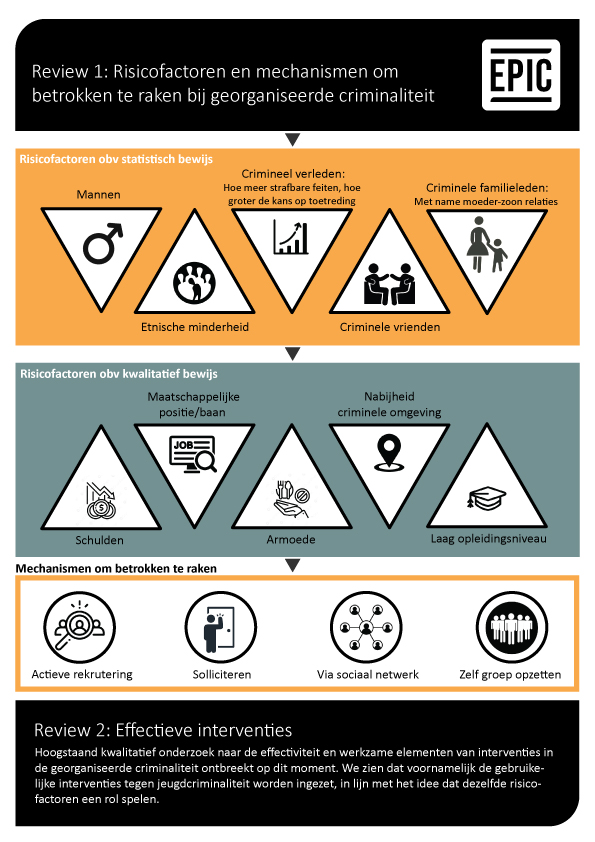
- Download this infographic with the most important findings (in Dutch):
Review 1: Risicofactoren en mechanismen om betrokken te raken bij georganiseerde criminaliteit (pdf) - Please find the open access article on:
The risk and protective factors for entering organized crime groups and their association with different entering mechanisms: A systematic review using ASReview
Reference: Adamse, I., Eichelsheim, V., Blokland, A., & Schoonmade, L. (2024). The risk and protective factors for entering organized crime groups and their association with different entering mechanisms: A systematic review using ASReview. European Journal of Criminology.
Results of the systematic literature review in work package 2:
Effective interventions in serious and organized crime
- Open the open access article on JeugdInOntwikkeling.nl (in Dutch): Interventies Gericht op het Voorkomen en Verminderen van de Betrokkenheid van Jongeren bij Georganiseerde Criminaliteit
Reference: Boertien, E., Nguyen, Q., Van Deuren, S., Eichelsheim, V., & Blokland, A. (2024). Interventions Aimed at Preventing and Reducing the Involvement of Young People in Organized Crime: A Systematic Literature Review. Youth in Development.
Results of the survey for the available practical knowledge in work package 3:
Tacit Knowledge
In the first EPIC phase, the tacit knowledge about what works in interventions to prevent and reduce young people’s involvement in serious and organized crime was examined. This is knowledge that is present in practice, but cannot yet be found in scientific literature. In order to provide the most complete picture possible, the plans of ‘Prevention with authority’ of eight municipalities were analysed, interviews were held with municipalities and police officers, and focus groups were held with young people and youth workers.
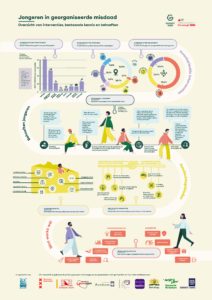
- This infographic in Dutch with the main findings: Jongeren in georganiseerde misdaad – Overzicht van interventies, bestaande kennis en behoeften (pdf)
- The full report Tacit Knowledge online and in Dutch: Inventarisatie van bestaande kennis rond interventies ter preventie van georganiseerde misdaad onder jongeren (pdf)
^ to menu
Phase 2 of EPIC
Phase 2 of EPIC: five empirical work-packages
The second phase first of all involves quantitative research (work package 4) on the prevalence of young people’s exposure to serious and organized crime in the Netherlands (how many?). This workpackage also examines the various risk and protective factors that influence the involvement in, persistence in, and desistance from organized crime (who, where and under what circumstances?). In particular, the role of criminal and social networks is examined.
In addition, the underlying mechanisms behind this involvement are explored through qualitative research methods (work package 5), including interviews with young people who are or have been involved in serious and organized crime, as well as analyses of criminal investigation files (why?).
Finally, three research projects focus on evaluating and further developing (preventive) interventions through action research (workpackage 6) and on examining the effectiveness of interventions (workpackage 7 and 8).
The research is done in close collaboration with municipalities, practitioners, young people and parents.
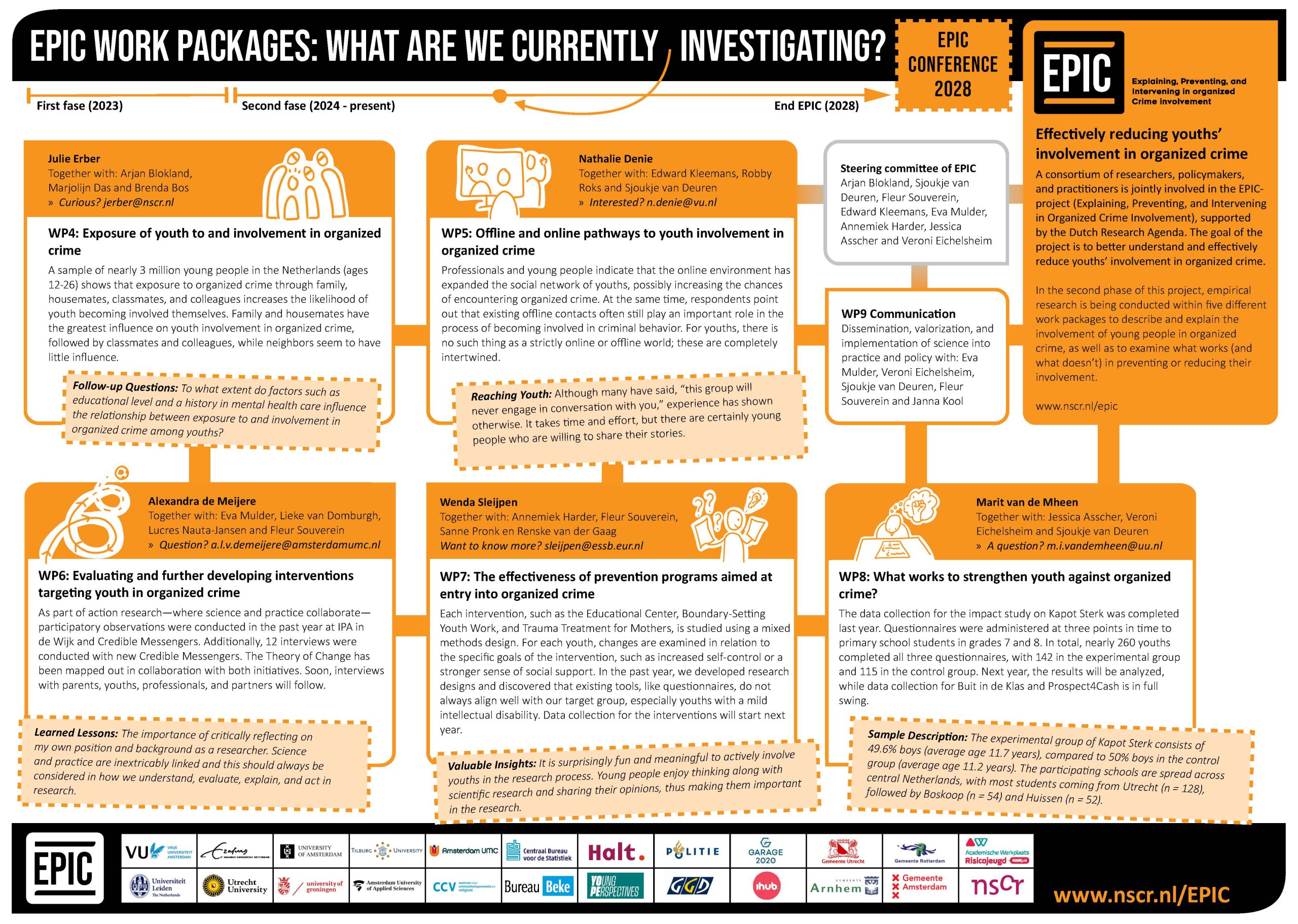
An overview of the work packages: Who is examining what?
Who is examining what? (juni 2025)
^ to menu
Phenomenon-based research in work package 4:

Exposure of young people to and involvement in organized crime
Research question: To what extent is exposure to organized crime within an individual’s network related to involvement in organized crime among young people?
Research method: unique network data from Statistics Netherlands, we compare the proportion of criminally involved individuals within young people’s networks and examine how this influences their involvement in organized crime.
Preliminary results: Based on CBS register data covering nearly 3 million young people in the Netherlands (12-26 years), exposure to organized crime through family, housemates, classmates and colleagues appear to increase the likelihood that young people become involved themselves. Family members and housemates exert the strongest influence, , followed by classmates and colleagues, while neighbours seem to have little influence on young people’s involvement in organized crime.

This research is being conducted by Julie Erber (PhD), Arjan Blokland, Marjolijn Das, Steve van de Weijer and Brenda Bos. Questions about this research? Mail Julie Erber
^ to menu
Phenomenon-based research in work package 5:

The online and offline pathways through which young people become involved in serious and organized crime
Research questions: How do young people become involved in serious and organized crime? To what extent and in which ways do social media platforms play a role in this?
Research method: We conduct interviews with both professionals – such as youth workers and police officers – and young people who are/were or ‘at risk’ for becoming involved in organized crime in two Dutch cities (Amsterdam and Arnhem).
Preliminary results: Professionals and young people report that the online environment has expanded young people’s social networks, which may also increase the likelihood of coming into contact with serious and organized crime. At the same time, respondents emphasize that existing, offline contacts often still play an important role in the process of becoming involved in criminal behaviour. For young people, there is no strict distinction between the online and offline world; the two are fully intertwined.

This research is being conducted by Nathalie Denie (PhD), Edward Kleemans, Robby Roks and Sjoukje van Deuren. Questions about this research? Mail Nathalie Denie
^ to menu
Action research in work package 6:

Evaluating and further developing interventions aimed at reducing young people’s involvement in serious and organized crime
Research questions: What is the goal of the intervention, which resources and methods are used to achieve these goals, what is the added value, what are effective elements and what are opportunities for further development of the intervention?
Research method: In close collaboration with practitioners and young people, action research is used to investigate what works, for whom it works, and how the intervention can be gradually optimized. The researcher conducts participant observations and interviews with professionals, young people, parents and partner organizations.
Progress update: We started with construing the theory of change on paper for each invention in close collaboration with the initiatives. The theory of change will be examined both in light of existing scientific knowledge as experiences in practice. As part of the action research approach – in which science and practice work together – participant observations were carried out in the past year at the interventions. In addition, 12 interviews were conducted with professionals. More interviews with parents, young people, professionals and cooperation partners will follow soon.
Interventions and programs:
- IPA in de Wijk is an umbrella term for various activities carried out by IPA in de Wijk worker undertakes in neighbourhoods and districts designated by the municipality where there is nuisance and crime committed by young people.. The IPA in de Wijk workers contribute to the early identification and assessment of risks and aim to connect young people who require help with the appropriate care provider. IPA in de Wijk operates within the extensive professionals network in the neighourhoods building bridges and bringing in forensics expertise.
More information: IPA in de Wijk | Levvel - Credible Messengers are professionals whose lived experience aligns with that of the young people they work with. They have deep, experiential knowledge of street culture and language, criminal networks, and the justice system, and they are rooted in different neighbourhoods across the city. Credible messengers have transformed their own negative experiences and serve as living examples of how to change one’s life. They are trained, coached and educated within the Amsterdam network organization ADAMAS. They support young people in staying away from criminal pathways, for example through talent development and building a pro‑social network, and can act as a bridge between young people and the care or support they need.
More information: ADAMAS Amsterdams Netwerk van Credible Messengers - Early Detection and Preventive Approach to Children with Complex Behaviour focuses on the early identification of aggressive, boundary‑crossing, and antisocial behaviour in primary school‑aged children. It then provides system‑oriented interpretation and intervenes with the lightest but most appropriate support. The aim is to detect complex and challenging behaviour in young children at an early stage to prevent behavioural problems later in life.

Deze drie interventies worden onder leiding van Eva Mulder, Fleur Souverein, Lucres Nauta-Jansen, Lieke van Domburgh en Alexandra de Meijere (PhD kandidaat). Vragen over dit actieonderzoek? Mail Alexandra
^ to menu
Effect study in work package 7:

The effectiveness of prevention programmes aimed at preventing entry into serious and organised crime
Research questions: To what extent are the interventions ‘Educational Centre’ and ‘Boundary Youth Work’ effective? What are effective elements? And for whom?
Research method: We use several methods ofof research. The starting point of the effectiveness study is to answer questions such as Does it work?’ (effectiveness), ‘What and how does it work?’ (mechanisms) and ‘Who does it work for?’ (target group). The interventions are studied using a mixed‑methods design, combining quantitative methods (such as questionnaires) with qualitative methods (such as interviews, focus groups, and diary notes). For each young person, we examine what changes occur during and after their participation in the intervention. We also investigate which factors, according to young people and professionals, contribute to these changes.
Progress update: Over the past year, we have developed the research designs. In doing so, we discovered that existing instruments, such as questionnaires, do not always align well with our target group. For young people with mild intellectual disabilities in particular, instruments often prove too complex. In addition, strict, effect-measuring research designs do not always fit in well with the complex reality of practice, which is dynamic and sometimes unpredictable. Data collection at the Educational Center has now started. In the coming year, we will also begin data collection for Grenzenstellend Jongerenwerk.
Interventions and programs:
- Education Center (iHub) is a school for special secondary education in Rotterdam. Young people between the ages of 15 and 19 who are stuck in regular education because regular schools do adequately meet their needs and strengths get a second chance at education here. The Educational Centre offers an integrated programme of care and education and aims to guide young people towards a suitable next step (on the labour market or further education). More information: Introductie – iHub onderwijs
- Setting boundaries for youth work is a form of youth work in Rotterdam aimed at reducing youth nuisance and youth crime. Youth workers do this by being actively present in the living environment of young people: on the street, at school and online. They also support young people through individual guidance programmes. The goal is to help young people progress in life domains where they experience challenges (such as school, work, housing) and preventing involvement in crime. More information: Grenzenstellend Jongerenwerk – Stichting JOZ

This research is being conducted by Wenda Sleijpen (PhD), Annemiek Harder, Fleur Souverein, Sanne Pronk and Renske van der Gaag. Questions about this research? Mail Wenda Sleijpen
^ to menu
Effect study in work package 8:

What works for youth in desisting and resisting from organized crime?
Research question: To what extent are the programs Kapot Sterk, Buit in de Klas and Prospect4Cash, effective in achieving their goals? What works, for whom and under what circumstances?
Research methodology: The study consists of quantitative questionnaire research using pre‑, post‑, and follow‑up measurements. Two programs (Buit in de Klas and Kapot Sterk) are being evaluated through a Randomized Controlled Trial to ensure that any observed changes can be attributed to the intervention. Prospect4Cash is being examined using a repeated SCED design.
Progress update: Last year (2025), data collection for the effect study on Kapot Sterk was completed. Questionnaires were administered to pupils in groups 7 and 8 at three time points. In total, almost 260 young people completed all three questionnaires, including 142 in the experimental group and 115 in the control group. The results will be analysed this year (2026). Data collection for Buit in de Klas will be completed in July 2026, and the study on Prospect4Cash is still ongoing.
Interventions and programs:
Prospect4Cash targets young people aged 16 to 21 and aims to help them findand keep a job. The program supports young people in bringing structure to their daily lives by making (work‑related) agreements and identifying their talents. Its goals include securing suitable work or internships, developing employee skills, and preventing involvement in crime.
- Buit in de Klas is an educational package for young people aged 12 and older. Its main aim is to prevent criminal exploitation by raising awareness of the issue and strengthening young people’s resilience. The lessons teach what exploitation entails, how and why someone may end up in an exploitative situation, and how to recognize signs of exploitation in their environment. More information: Buit in de Klas
- Kapot Sterk is a preventive education program designed to help relatively young children (groups 7 and 8 of primary school) resist the temptations of more serious forms of crime. The program consists of several lessons that aim to increase children’s awareness and resilience against the influence of serious crime. More information: Kapot Sterk

The research is being done by Marit van de Mheen (PhD), Jessica Asscher, Veroni Eichelsheim and Sjoukje van Deuren. Do you have a question? Mail Marit van de Mheen
^ to menu
Phase 2, more info
- June 2025 – Interim overview – Who investigates what?
Infographic Who investigates what? (pdf) and printable version (A3) (pdf) - Dec 2025 – Interim overview – What are we currently researching?
Infographic: What are we currently researching? (pdf) - Sept 2026 – Interim overview – Myths and misconceptions about youth crime and effective interventions
Infographic: Myths and misconceptions (pdf) - The EPIC project on NWO.nl
Getting a grip on juvenile delinquency
^ to menu
EPIC’s research team and collaboration partners
The EPIC project was developed and is carried out by a consortium of researchers, policymakers and practioniores , with support from the Dutch National Science Agenda (NWA).
- EPIC Steering Committee: Prof. dr. Arjan Blokland, project leader, Prof. dr. Veroni Eichelsheim, Prof. dr. Frank Weerman, dr. Sjoukje van Deuren, dr. Fleur Souverein, Prof. dr. Eva Mulder, Prof. dr. Annemiek Harder, Prof. dr. Jessica Asscher and Prof. dr. Edward Kleemans.
- WP 4 – Youth exposure to and involvement in organised crime:
Julie Erber, Arjan Blokland, Marjolijn Das, Brenda Bos and Steve van de Weijer - WP 5 Offline and online paths to the involvement of young people in organised crime:
Nathalie Denie, Edward Kleemans, Robby Roks and Sjoukje van Deuren - WP 6 – Evaluating and further developing interventions aimed at the involvement of young people in organised crime:
Alexandra de Meijere, Eva Mulder, Fleur Souverein, Lucres Nauta-Jansen and Lieke van Domburgh - WP 7 – What works to prevent young people from becoming involved in organised crime?
Wenda Sleijpen, Annemiek Harder, Fleur Souverein, Sanne Pronk and Renske van der Gaag - WP 8 – What works to make young people resilient against organised crime?
Marit van de Mheen, Jessica Asscher, Veroni Eichelsheim and Sjoukje van Deuren - WP 9 – EPIC communication:
Eva Mulder, Fleur Souverein, Sjoukje van Deuren, Veroni Eichelscheim and Janna Kool
Vrije University Amsterdam, Erasmus University Rotterdam, University of Amsterdam, Tilburg University, Leiden University, Utrecht University, Groningen University, Leids University Medical Center (LUMC), Amsterdams University Medical Center (AmsterdamUMC), Amsterdam University of Applied Sciences, Statistics Netherlands (CBS), Bureau Beke, HALT foundation, Young Perspectives, Centre for Crime Prevention and Safety (CCV), Academic Collaborative Centre for At-Risk Youth (AWRJ), Municipal Health Service (GGD), iHub Education & Family Care, Police Amsterdam en the municipalities of Amsterdam, Rotterdam, Utrecht and Arnhem.
^ to menu
Contact
- Do you have substantive questions about the different work packages, the interventions, or are you curious about the researchers’ experiences in the field? Would you like to invite one of the researchers to give a presentation at your organization or municipality?
- Questions about phenomenon-based research, action research or effect study?
For more information about EPIC research, please send an email to epic@nscr.nl. You can also visit the EPIC linkedin page (in Dutch)
^ to menu

NSCR is part of the Institutes Organisation of the Dutch Research Council (NWO).